From Butaro to Boston: UGHE Medical Students Bring Rwandan Clinical Insight to Brigham and Women’s Hospital
Students from the University of Global Health Equity in Rwanda travel to Boston to complete a clerkship at Brigham and Women’s Hospital.
Posted on Nov 2, 2026

For Winny Stella Abera, a Rwandan medical student at the University of Global Health Equity (UGHE), a clerkship in Boston was a chance to learn and put her training to work in one of the most heavily resourced health systems in the world. But as she quickly came to experience, patient care goes beyond just having the right resources.
Winny Abera is one of 16 students from UGHE who have participated in a clerkship at Brigham and Women’s Hospital (BWH) in Boston as part of the Paul Farmer Collaborative, a program rooted in health equity and built for knowledge sharing and clinical growth. Medical students from UGHE travel to Boston to participate in clinical rotations at BWH alongside Harvard Medical School (HMS) students. In return, BWH residents and HMS students rotate at UGHE’s partner teaching hospitals.
"I was coming as a student trained in Rwanda, including in rural and resource-constrained settings, where you often have to think creatively about how to deliver the best possible care with limited resources,” Winny Abera said. “I wanted to bring that perspective to BWH while learning from a system with very different resources and approaches.”
Mutual Learning
A major emphasis of the Paul Farmer Collaborative’s student exchange program is built on equitable partnership and reciprocal learning and is co-led by faculty at UGHE and HMS.
“I believe the experience reinforces an important message: our students belong in international academic and clinical environments,” said Dr. Solomon Nega Techane, assistant professor and head of the Department of Internal Medicine at UGHE.
When students from UGHE participate in patient care at BWH, they aren’t simply observing. For Ernest Aben Oumo, a fifth-year UGHE Ugandan medical student, being trusted to be actively involved was critical to his experience.
“Patients and their families trusted me with their life stories, while residents, interns, and attending physicians trusted me to take histories, perform examinations, participate in clinical discussions...” he said. “That trust made the experience much more than an opportunity to observe. It allowed me to learn from patients as people and challenged me to think about the kind of physician I hope to become.”
Many of the students who applied for this clerkship were excited about the opportunity to compare how care is delivered in two very different health systems, and to test their own training in a new setting. Ada Mola, a UGHE medical student, saw this as an opportunity to get out of her comfort zone.
“I wanted to challenge myself by learning in an unfamiliar environment,” she said. “At UGHE, we are constantly encouraged to think about equity, access, and the context in which health care is delivered, so I was curious to see how those ideas played out in a major U.S. teaching hospital."
Reinforcing Patient-Centered Care
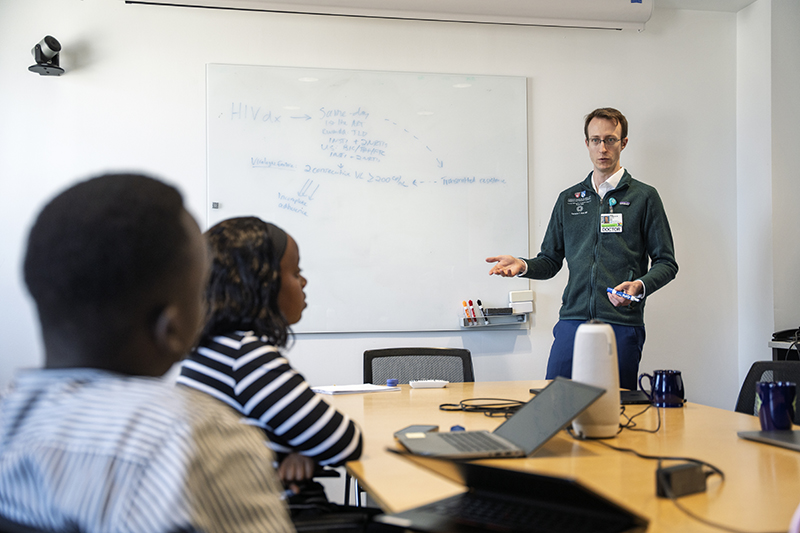
The clerkship was designed and is led jointly by faculty at both institutions. At UGHE, Dr. Solomon Techane, Dr. Natalie McCall, chair of the Division of Clinical Medicine, and the UGHE Academic Partnership team selected and prepared students, shaped the clinical learning goals, and supported them before, during, and after the rotation. For HMS and BWH, Dr. Cameron Nutt, an infectious disease specialist, led the program alongside other key BWH faculty—including Dr. Joe Rhatigan, Dr. Elizabeth Petersen, and Dr. Christopher Calahan—with the same values that UGHE instills in its students, always keeping the patient at the center.
For Winny Abera, the clerkship deepened a way of thinking that is central to UGHE’s approach to medicine: the idea that understanding a patient’s life is inseparable from understanding their illness. Working with Dr. Nutt, who brought the same lens to the wards at BWH, sharpened it further.
“[Dr. Nutt] emphasized that caring for a patient begins with understanding their social background, because it is essential to understanding both the illness and the treatment goals,” Winny Abera said. “It changed the question I ask myself from ‘What disease does this patient have?’ to ‘Who is this patient, what shaped their illness, and what can we realistically do to help?'"
Ernest Oumo had a similar experience when an elderly patient was being transitioned to comfort-focused care, and his team worked with the patient and his family to determine how he could spend the remainder of his life with dignity, outside of the hospital.
This patient-centered care often reminds students that the fundamentals of their work remain consistent, regardless of the level of clinical care or resources available. Patients can, and should, always be treated with respect.
From Butaro to Boston and Back
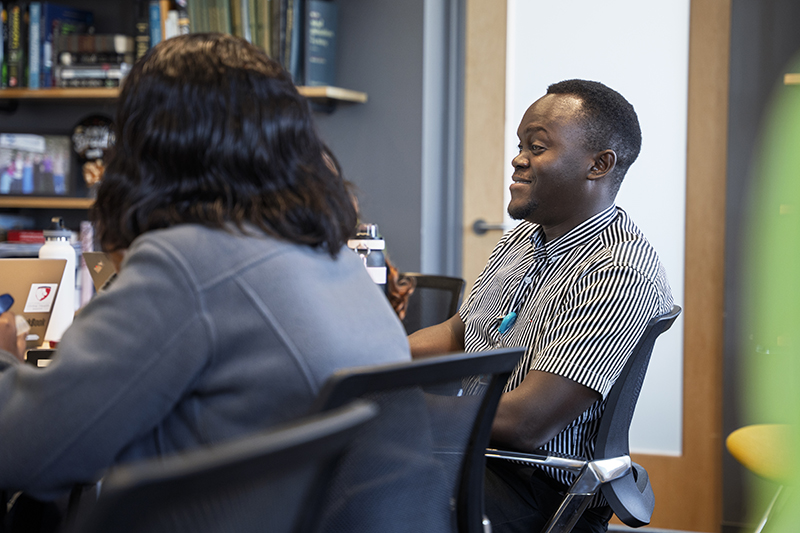
Many students leave the program with a deeper understanding of the intricacies of patient care, and that whether you’re supporting patients in rural Rwanda or downtown Boston, each system will have its own unique strengths and challenges.
“I was surprised by how much the experience challenged the idea that having more resources automatically means having an equitable health system,” Ada Mola said. “I saw how insurance, socioeconomic circumstances, and geography can still affect people's ability to access care in the United States.”
The clerkship gives students a critical lens on both health systems, challenging the common assumption that more resources mean better or fairer care. It also helps them grow as clinicians, adapting what they’ve learned at UGHE to the wards at BWH, and vice versa.
“The goal is not for students to return to Rwanda and replicate everything they have seen at BWH,” Dr. Solomon Techane said. “Rather, we want them to develop the judgment to identify practices that are valuable, understand why they work, and consider how those principles can be adapted to the realities of patient care in Rwanda.”
Overall, the learning runs in both directions: UGHE students leave Boston with new perspectives, and BWH teams and HMS students are reminded that clinical excellence is shaped by context, not just resources. Through this partnership, the Paul Farmer Collaborative is helping shape future generations of global health leaders who are equipped with diverse clinical skills and a deep understanding of social justice.
On his experience, Ernest Oumo shared: “I hope that wherever my career eventually takes me—whether at the bedside, leading a clinical team, or perhaps one day shaping policy, I will carry these lessons with me: that quality health care should be patient-centered, equitable, and grounded in dignity, and that our responsibility extends to those who may not otherwise have a voice.”
Future Health Leaders
Meet the graduates of UGHE’s first medical class and 10th master’s class as they celebrate their achievements and prepare to shape a more equitable future in health care.