Congress Funded Global Health. The Office of Management and Budget Is Trying Not To Spend It.
Two PIH experts analyze what is happening to global health funds that aren’t being spent as they were allocated by Congress.
Posted on Aug 17, 2026

Editor’s note: This piece was written by Vicent Lin, PIH Associate Director, Health Policy & Advocacy, and KJ Seung, a physician and global health researcher at Mass General Brigham and PIH advisor, and originally published by the Health Security Policy Academy.
The New York Times reported recently that:
"...despite the recent announcements, large amounts of congressionally appropriated funding for global health and foreign aid remain unspent, or marked for likely rescission.
The Office of Management and Budget (OMB), headed by Russell T. Vought and charged with shutting down U.S.A.I.D., in April notified Congress of a plan to use $2 billion of global health money for "closeout costs" for grants from the dismantled U.S.A.I.D. — costs such as severance to employees and terminating leases for office space around the world.
Since that notification, about $650 million of those funds have been redirected for the Ebola response and other global health security efforts. But $1.35 billion, which has to be used by Sept. 30, remains marked by the O.M.B. for closeout costs."
Let's break that down.
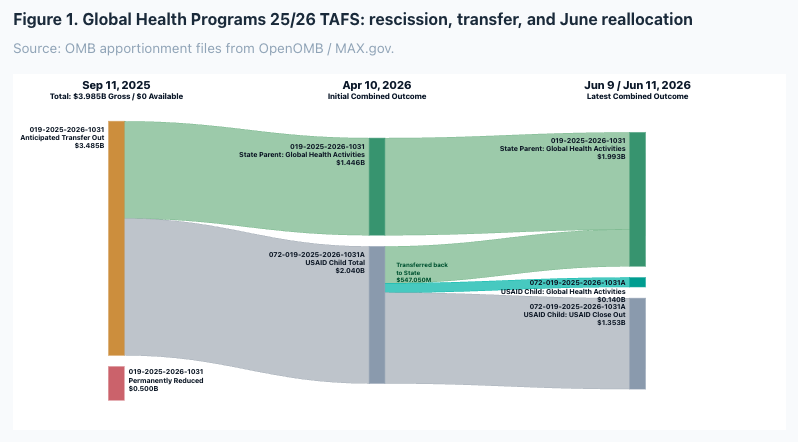
Read from left to right, the first column of Figure 1 shows the September 2025 starting point for the Global Health Programs 25/26 account: a $3.985 billion gross appropriation, reduced by a permanent $500 million rescission.
The context for that first column is the fiscal year 2025 appropriations process. Congress funded these global health programs, then the administration asked Congress to claw some of the money back. Congress agreed to a rescission package that permanently rescinded $500 million from Global Health Programs funding.
The middle column shows what happened in April 2026. $2 billion was moved to a United States Agency for International Development (USAID) child account with the label "USAID Close Out."
That $2 billion from the Global Health Programs account was actually part of a much larger chunk of money set aside for USAID closeout. Senator Jeanne Shaheen has said the administration notified Congress of plans to use as much as $19 billion in previously appropriated funds to close out roughly 5,600 terminated foreign assistance awards, despite evidence that actual closeout costs were only a fraction of that amount.
USAID was dismantled more than a year ago, and almost all of the terminated USAID awards have been closed out already. The administration has never explained why it is holding billions of dollars in limbo, despite questions from Senator Shaheen and others.
And then in May, Ebola exploded in the Democratic Republic of Congo (DRC).
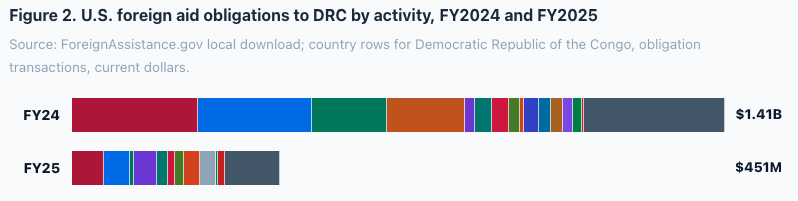
U.S. assistance to DRC had already collapsed in FY2025, one of the reasons why the U.S. was caught unaware that an outbreak was brewing for months. U.S. aid to DRC fell from $1.4 billion in FY2024 to $451 million in FY2025, a two-thirds reduction.
After the World Health Organization declared a public health emergency for the Bundibugyo Ebola outbreak in DRC, the outbreak continued to grow exponentially, becoming the fastest-growing Ebola outbreak in the virus's history.
Under that pressure, the administration began mobilizing money for Ebola and global health security. In June (Figure 1, right column), OMB unexpectedly moved about $547 million out of the USAID closeout structure and back toward "Global Health Activities." Sources tell us this movement is part of a broader restoration of global health security funding to roughly $700 million.
After that shift, about $1.35 billion still remains marked for "USAID Close Out," and about $140 million remains in the USAID-side account but is relabeled for "Global Health Activities" for reasons that are not clear from the apportionment alone.
OMB still controls the timing, routing, and classification of these funds. State can administer programs only after the money is apportioned and made available. If OMB keeps funds parked, slow-walks apportionments, or shifts balances at the last minute, State cannot solve that problem by itself.
This is why the issue extends beyond global health. Russell Vought has long argued for aggressive executive control over spending. Foreign aid is a politically vulnerable and poorly understood area of the budget. If OMB can use apportionments, transfers, closeout labels, and timing to avoid executing foreign aid appropriations, it can try the same approach elsewhere.
As the fiscal year closes, there are several ways this could play out:
- Vought could attempt a pocket rescission between August 15 and September 30, positioning the funds to expire before Congress can force action.
- Vought could quietly let the money expire, achieving the same practical result without a formal rescission fight.
- Vought could spend some money on real closeout costs, while leaving most of the balance unspent. Actual closeout costs may exist, but they are unlikely to explain a billion-dollar holdback.
- Vought could transfer money to another agency at the last moment, potentially extending the period of availability and moving the fight into a different account.
- Vought could transfer money to the State Department's Global Health Security and Diplomacy bureau and require GHSD to move it before the end of the fiscal year. That would get some money out the door, but on a compressed timeline shaped by apportionment decisions rather than normal program planning.
There could also be some combination of the above scenarios. Some funds could be released for Ebola, some spent on closeout, some transferred, and some left to lapse.
Congress already made the policy choice when it appropriated this money for global health. OMB is now controlling whether, when, and where that money becomes available. Congress should demand that OMB release the $1.35 billion and require a public accounting before the fiscal year ends.
Take Action
Join PIH in advocating for the release of lifesaving global health funding.