"He’s My Angel": The Vital Role Community Health Workers Play in New Jersey
In 2023, Partners In Health United States (PIH-US) leveraged partnerships to support the staffing of community health workers in Newark, New Jersey. Since then, they have become a pivotal part of the community.
Posted on Dec 18, 2025

Omar Clay can’t go more than a few steps without being met with a hug, handshake, or question as he strides through the Newark Department of Health and Community Wellness.
He points people in the direction of free food while simultaneously picking up his phone to schedule an Uber ride for a patient. When he passes people in the department’s fluorescent halls, he asks them about follow-up appointments, how they are feeling, and whether their family members are doing well.
It’s all these small conversations that help make up essential, comprehensive care. For Clay, it’s just a typical day of work.
Clay, one of the department’s three community health workers (CHWs), is determined to get people access to the health care they deserve—sometimes this means organizing transportation to a doctor’s appointment, helping them find housing, or navigating insurance alongside them.
“We are—in real time—ensuring that our clients are getting exactly what they need as fast as they possibly can,” Clay said.
Partners In Health (PIH) believes in the power of community-based medical and social support. Programs involving CHWs, who are local residents that act as advocates and guides for their patients in the health system, are an essential part of providing comprehensive care and grew out of PIH’s work in Haiti. Now, PIH supports more than 12,000 CHWs worldwide.
In 2023, Partners In Health United States (PIH-US) leveraged its partnership with the Newark Department of Health and Community Wellness to support three community health worker positions, with funding through Acenda and the New Jersey State Department of Health. Since then, the CHWs have become a pivotal part of the community—and in recognition of their importance—the city has taken on supporting these roles financially.
A Day in the Life of a Community Health Worker in Newark
For CHWs, no two days are alike—but they are always busy.
Some days, Clay is at the department for hours with patients, learning about their medical needs or helping them work through paperwork between fielding calls from others.
Other times, Clay works to bring health care directly in front of the people who need it most.
A team made up of medical assistants, insurance navigators, and CHWs travels to different areas of Newark to operate mobile clinics. The clinic—a medical RV—is designed to have two examination rooms, a waiting area, and on-sight testing to get results back to patients within minutes.
The department partners with other groups to bring health care directly to people who often have limited access, including hosting clinics in the parking lots of city-run low-income housing complexes.
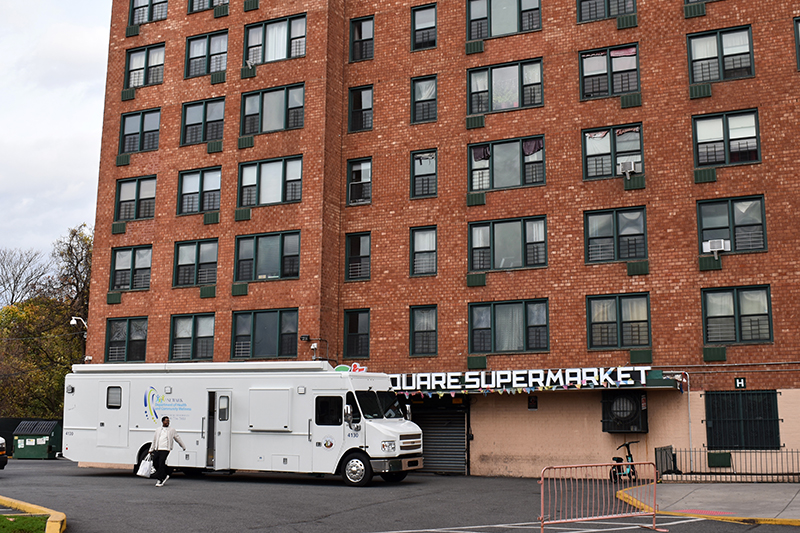
On November 14, the team spent hours with residents at one complex, testing their glucose levels, blood pressure, and providing free HIV testing.
While two CHWs with the Department of Health and Community Wellness—Clay and Jahaida Figueroa—operated the mobile unit, another CHW, Rose Rock, remained at the department to work with other patients.
Rock has a unique skill that helps her connect with patients and ensure they are listened to and understood: she speaks four different languages. At the department, she uses her skills in Haitian Creole, French, Spanish, and English to help community members.
Together, the CHWs make a robust team full of empathy and expertise.
“I couldn't do it without them,” Clay said. “They couldn't do it without me. We are very much intertwined."
In addition to providing on-site care, CHWs use this as an opportunity to connect people with other health resources.
Figueroa offered residents the option to receive additional care from primary care physicians, pediatricians, and behavioral health professionals in the hours she spent at the mobile clinic.
If people need those services but have barriers to accessing them—whether they are overwhelmed by the process, unable to afford the visit, don’t have transportation, or another reason—CHWs step in to support them getting the care they need.
“It's hard to really put a classification on (the work), but basically the best way to say it is advocating and navigating through the healthcare system for our clients,” Clay said. “And not just health, because once you address the social determinants of health that it makes it very broad.”
When Clay references the “social determinants of health,” he is talking about the non-medical, environmental, and social factors that impact a person’s overall well-being, including housing, food, education, and employment.
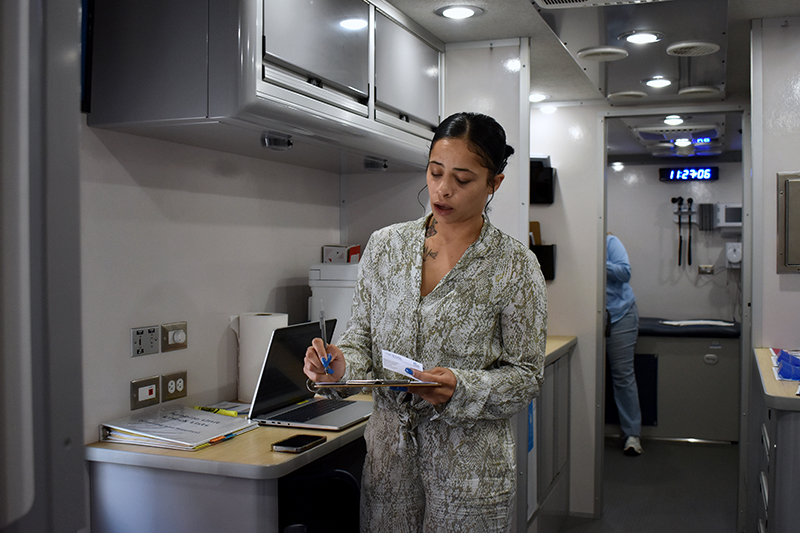
“I feel like a lot of people don't understand how things in your daily living can affect your health and how it goes hand in hand,” Figueroa said. “When we help these people with rental assistance, food insecurity, housing insecurity, shelter placement and all of that, it puts them in a different...”
“It lowers their blood pressure,” Clay said.
“It can lower their blood pressure,” Figueroa echoed.
‘My Angel’: Building Family Through Community Health
Andrew Adupoku calls Clay his “angel.”
Adupoku began coming into the department to get treatment for pain in his teeth.
When a doctor discovered he needed antibiotics, Clay connected him to a program in the department that exponentially lowers medication costs. And when Adupoku still came up short, Clay stepped in to cover the cost.
Another patient, Alexander, said Clay worked with him for a year to find permanent housing. Now, he is spending his first nights in his new home, finally out of a shelter.
In the meantime, Clay is tracking down pillows, sheets, and other supplies for the apartment.
Clay is there for his patients—no matter what they are going through. Building trust and offering exceptional service has been an essential part of his work. With this foundation, patients return again and again.
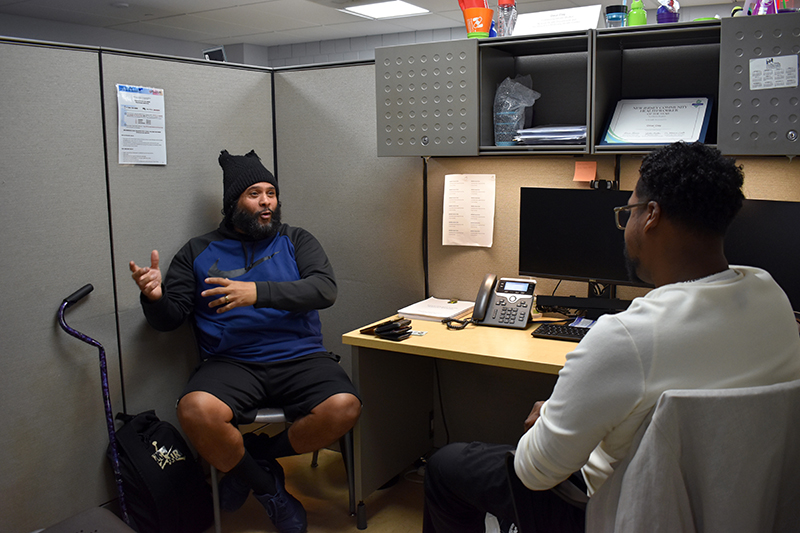
“That person will come back, and it could be nothing to do with what we offer,” Clay said. “'Oh, I'm having an issue with social security.’ And I'll look (at them) like, ‘Well, you know I don't work with social security, but you know what? I'm going to take my break. I'll take you over there and we'll sit down and we'll figure it out.’”
For the people dedicated to this work, it has become a lifestyle—and a family. Former patients call Clay their grandson or their children’s uncle, and clap him on the back as he roams through the department halls.
“All three of us (community health workers) have done these Uber rides hours after we've clocked out, sometimes hours before (we clock in),” Clay said. “And some of our clients have our personal number, so they're calling us Saturdays and Sundays.”
Clay always answers the call.
“What we're doing is eliminating those emergency room visits, the wasted medication, the wasted referrals,” Clay said.
For years, PIH-US has advocated for community health workers to be a fixture of the health care system in the U.S. so patients around the country can experience the accompaniment someone like Clay can provide. PIH-US, which grew from the U.S. Public Health Accompaniment Unit created during the COVID-19 pandemic, is set to conclude its public health advising work in the spring 2026. However, its legacy will live on, both in the CHWs already embedded in communities, and in the national CHW organizations we have worked to build in collaboration with our partners.
We are profoundly grateful for this incredible network of caregivers and our partners as they carry on this vital work.