“I Want To Get Well”: The TB Treatment Journey of an Indigenous Woman in Peru
Elia survived extreme grief only to begin another battle when she was diagnosed with tuberculosis.
Posted on Aug 5, 2026

Editor’s note: This article was originally published in Spanish on Socios En Salud’s website.
In 2020, during the COVID-19 pandemic, Elia Bardales lost her 28-year-old daughter to an illness that no hospital could fully explain. That loss left her with a sense of guilt that still makes her voice break when she remembers it. It was during those months of mourning that she began to neglect her eating. She did nothing but sleep.
"I had no appetite, thinking about it—about so many things. I would just weep at the memory of my daughter," she recalls.
As time went on, the discomfort did not go away. One day, while bathing, she felt an unusual chill. That was the first time she thought something else might be going on—that perhaps it wasn't just sadness manifesting in her body.
Several years passed before she found an explanation.
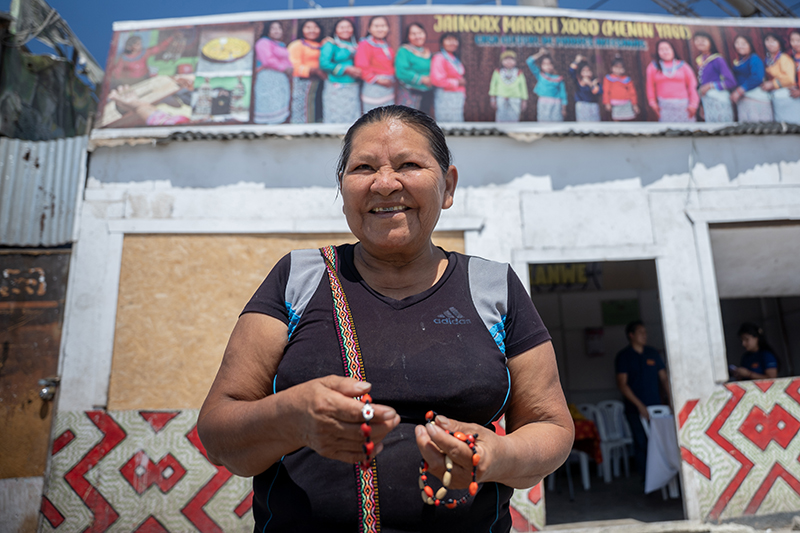
In November 2024, a tuberculosis screening team from Socios En Salud (SES), as Partners In Health is known in Peru, arrived in Cantagallo—an urban settlement of the indigenous Shipibo-Konibo people on the banks of the Rímac River in Lima, where Bardales has lived for over two decades. During the team's visit, she decided to go over and get screened.
"They made me hug the machine, and I saw my lung on the screen. It looked dark and mottled," she says, describing the portable X-ray unit.
The health care worker attending to her asked why she was so thin. "I had never really looked at myself in the mirror. I saw that I looked gaunt—my face was very thin," she recalls.
The screening tests confirmed that it was more than grief that was wrecking Bardales’ body. She was diagnosed with tuberculosis and began treatment immediately.
Surviving the Treatment
Her treatment had barely begun when complications arose. A couple of months later, in January 2025, the treatment had to be suspended due to impaired liver function and a severe allergic reaction to the regimen she was given.
Fortunately, she had the accompaniment of a community health worker from SES, as the following months included numerous appointments between pulmonologists and dermatologists trying to sort out the root of her reaction. In May, tests revealed an unexpected cause: abnormal nickel levels in her blood were contributing to the allergic reaction.
Her doctors then prescribed a new regimen that included injections. Unfortunately, this medication triggered a reaction again, and the treatment had to be halted once more. There were days when she couldn't even get up to give her granddaughters water; the girls, seeing how ill she looked, didn't want to go to school.
Finally, a year after starting treatment, doctors put together an individualized regimen to address the adverse drug reaction: six months of three types of oral medications. No injections.
"Now, if it doesn't fail me, I'm going to take the pills," she says.
After so many changes in treatment, her decision to continue taking medication was, for Bardales, an act of trust.
A Founder of Cantagallo
The fact that Bardales has made it this far—without abandoning treatment despite so many interruptions—also has to do with the life she had built long before her tuberculosis diagnosis.
She was born in Puerto Bethel, a Shipibo-Konibo community in the Peruvian Amazon, and arrived in Lima at a very young age. A friend from home had promised to meet her at the bus terminal but never showed up. She didn't know the city, barely spoke Spanish, and had nowhere to go.
A police officer approached her and asked if she had any family with her. She didn't.
"I didn't speak much Spanish; I didn't understand. I cried a lot," she recalls. "I would think of my mom... and say to myself: 'There are people who trick you.' And now here I am, stranded in the middle of nowhere."
The police officer ended up taking her to an aunt's house, but back in Puerto Bethel, her mother and siblings lost all contact with her.
It was a chance encounter that brought them back together. A family friend recognized her at Jorge Chávez International Airport and alerted her family. Shortly after, she received a call she had been waiting years for.
"They thought I was dead," she recalls.
Bardales then returned to her community to reunite with her family. Years later, at the age of 35 and with a newborn daughter, she returned to Lima to earn a living through handicrafts: embroidery, hand-painted blankets, and kené designs—flowing geometric patterns passed down through generations of Shipibo-Konibo people—she had learned as a child.
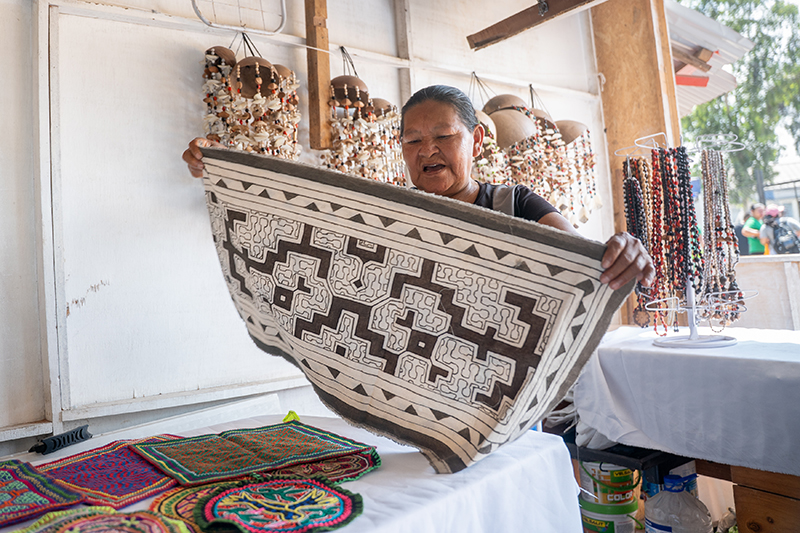
At that time, Cantagallo—where she now lives—did not yet exist as a settlement. Barely 30 Shipibo-Konibo families were beginning to gather to organize themselves and look for a place to live. Bardales was there from the very beginning.
"We arrived [in Cantagallo]... there were only 30 of us. We started holding meetings... and we stayed there. We are the founders," she recalls.
As part of that history, she also holds a name in the Shipibo-Konibo language: Yavi. It signifies, as she explains, "unity" and "harmony."
Weaving Again
Today, Bardales is raising two granddaughters on her own: one is three years old—the daughter of the child she lost—and the other is five, left in her care by another relative. She has no steady income; she lives off what she manages to sell at her handicraft stall, the support she receives from SES, and—occasionally—food baskets from the Ministry of Health.
During the toughest months of her treatment, she couldn't even sit down to sew. Gradually, as she got better, she returned to work.
As Bardales continues to heal, she embroiders and paints the kené designs she learned from her mother, and her two granddaughters continue preventive treatment for tuberculosis.
At one of the most difficult moments, a SES community health worker insisted once again: "Do you want to get well? Take your pills."
Bardales replied, "I want to get well."
She admits that she keeps repeating those same words to herself. Because of the two little girls who rely on her. Because there is still fabric waiting to be embroidered. And because, after a year in which even healing seemed to cause pain, she decided to keep going.