Two Generations, One Vocation: Meet Two Community Health Workers in Peru
Inela Espinoza and Alicia Domínguez embody community health as they serve their neighborhoods in Lima.
Posted on Jul 9, 2026

Editor’s note: This article was originally published in Spanish on Socios En Salud’s website.
Two women from different eras share the same drive: to look after those who live around them. Inela Espinoza has been working in Carabayllo for more than four decades; Alicia Domínguez has been doing it for less than ten years but already feels she could never stop.
Their stories began in very different contexts: one in the 1970s, amid inadequate health infrastructure and army-supported vaccination campaigns; the other before the start of the COVID-19 pandemic, learning on the fly the value of companionship in care. But both arrived at the same conviction: that serving their community is not just a job, but a way of life.
Today, Espinoza and Domínguez are part of a network of community health workers (CHWs) supported by Socios En Salud (SES), as Partners In Health is known in Peru. Their stories illustrate what this work means: sustained effort, genuine empathy, and a presence that the system often fails to provide.
Beyond the uniform and the projects they participate in, both CHWs share an upbringing that taught them the value of the lives of others and a conviction—renewed every day— to act accordingly.
From Clerk to District Coordinator
Espinoza was 18 years old when she began helping with vaccination campaigns at the Raúl Porras Barrenechea school in Carabayllo, an underserved area north of the capital of Lima. She wasn't looking for a job; she was simply there, near the health clinic, and the health staff knew her. That's how it all started: as a clerk on days when they had to convince migrant families that the vaccine wouldn't make their children sick.
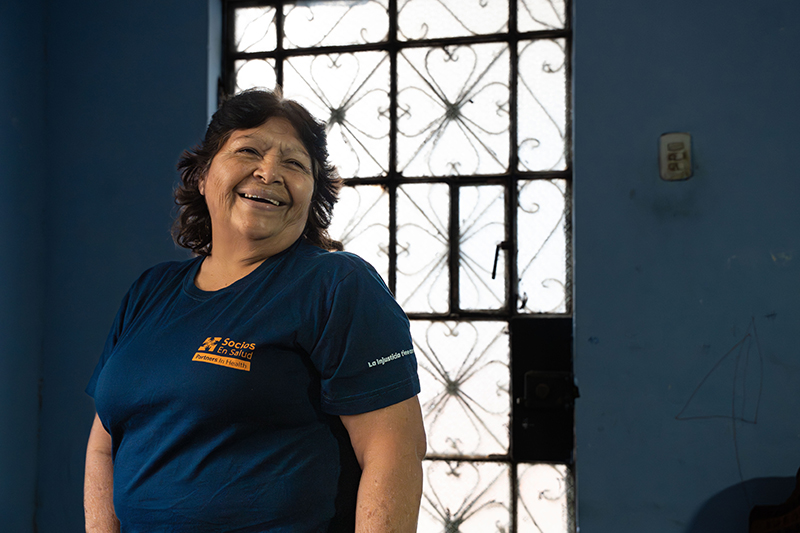
She went on to study nursing at an academy in her district and was about to graduate when her father passed away. As the eldest of seven siblings, she had to assume responsibility for the household and left school without her degree. However, her calling did not falter. She continued to volunteer at free medical clinics organized by the local parish with volunteer doctors.
In the 1980s, she joined the Vaso de Leche, or Glass of Milk, nutritional support program in Carabayllo, where she soon assumed the role of district health coordinator. Eventually, she led 800 health delegates throughout the district.
“We implemented communal spaces that were set up to treat people suffering from severe dehydration. We did this throughout the district and had about 430 of them, where rehydration salts were given to all the children who had diarrhea,” Espinoza recalls.
The Patients No One Else Was Treating
In 1996, through a network of contacts between the parish and other organizations, Espinoza was connected with SES, founded that same year by doctors Paul Farmer, Jim Yong Kim, Jaime Bayona, and advocate Ophelia Dahl. SES offered Espinoza something unexpected: a scholarship for a leadership course in Panama. The trip would last three and a half months. At the time, she already had young children, was president of the Vaso de Leche program, and had no experience with international travel. Even so, she decided to go.
When she returned, she discovered that SES had already begun working in Carabayllo with people affected by multidrug-resistant tuberculosis (MDR-TB), the most severe form of the disease.
Espinoza was called upon to help administer medications at home for SES’s MDR-TB patients. What she saw shocked her.
“We went door to door and found patients who were drinking water for breakfast. They were taking 11 pills, sometimes 18, simply with water in their stomachs,” she remembers. “SES didn't just deliver medications; it improved homes, provided food, and offered support.”
Espinoza recognized in that model something she had always practiced: comprehensive care is the only way for the treatment to work.
The Pandemic Generation
Decades after Espinoza got her start, Domínguez began her journey as a CHW in 2017 in Ventanilla, the district where she lives. She was invited because she knew her neighbors, knew what they needed, and—simply—had the time. The first thing she learned was how to make blood sausage burgers to combat childhood anemia. She had a young baby at the time, which drove her empathy.
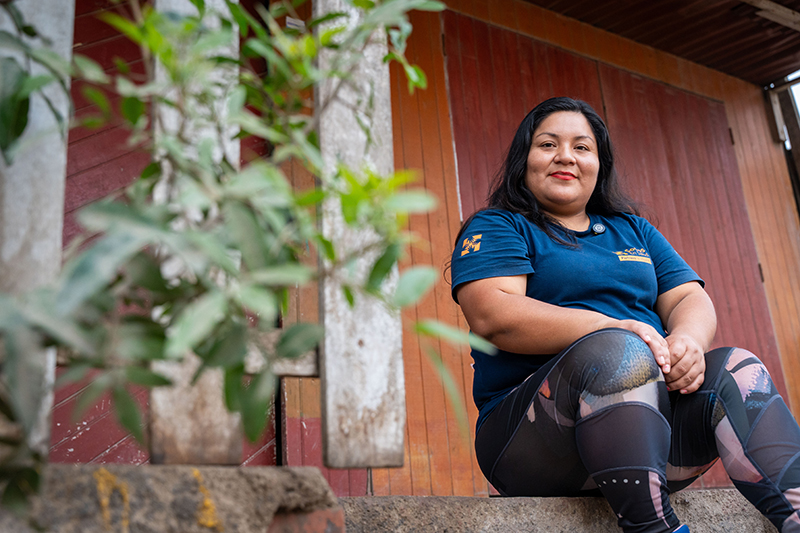
When the pandemic hit, Domínguez was offered a job assisting with COVID-19 care. She declined due to the risk it posed to her family, but in 2023, a colleague from the health center in Ventanilla invited her to join a vaccination campaign, asking her to volunteer her time to support the community once again.
She hasn't stopped since.
That same year, SES incorporated her into the Ally Wambra, or Healthy Child, project focusing on early childhood development and anemia prevention.
What she values most about working with SES, she says, is that no one judges or dismisses her if she can't attend one day: “They teach you to value yourself more as a person, as an agent. They don't judge you if you get sick or if you suddenly can't go out one day, they understand. That's what strengthens me the most.”
For Domínguez, that emotional support is as important as technical training.
Vocation as a Meeting Point
Despite the generational difference— Espinoza with decades of experience and a career spanning epidemics, government programs, and health system reforms; Domínguez still building her experience—both agree on the essentials when asked what it takes to be a CHW. The answer is the same: vocation.
For Espinoza, that vocation has a clear origin: her mother. “We went through many hardships, but my mother never refused a favor. The neighbor would come by and say, 'Do you happen to have a matchstick?' And even if we needed it, my mother would give it to them.”
That image defines how she understands her own work: not as a service rendered, but as a way of being in the world.
Domínguez, on the other hand, has a different image: “It’s like eating every day; you get hungry, and you feel like you’re missing something if you’re not involved in the project or working as a community agent.” And when she speaks of her colleagues, her voice fills with emotion: “We are strong, resilient women who give our all. Despite all the obstacles or problems we face in our lives, we keep going.”
CHWs are an important part of their communities, knocking on doors to raise awareness and provide support, with their only contract being their vocation of service.