My First Hill Day: Advocating for Tuberculosis Care
Senior Writer Kathrine Kuhlmann joined PIH's Advocacy Team in Washington, D.C., to meet with Congressional leaders and educate them on the urgent need for tuberculosis prevention and care.
Posted on Apr 25, 2025

When I signed up to join the Partners In Health (PIH) team for Tuberculosis (TB) Hill Day, I was excited: it would be my first visit to Washington, D.C. Raised by European parents, I’ve spent time wandering the grounds of grand castles—some still in use—throughout my life. But something about D.C. always felt mythical and out-of-reach by comparison.
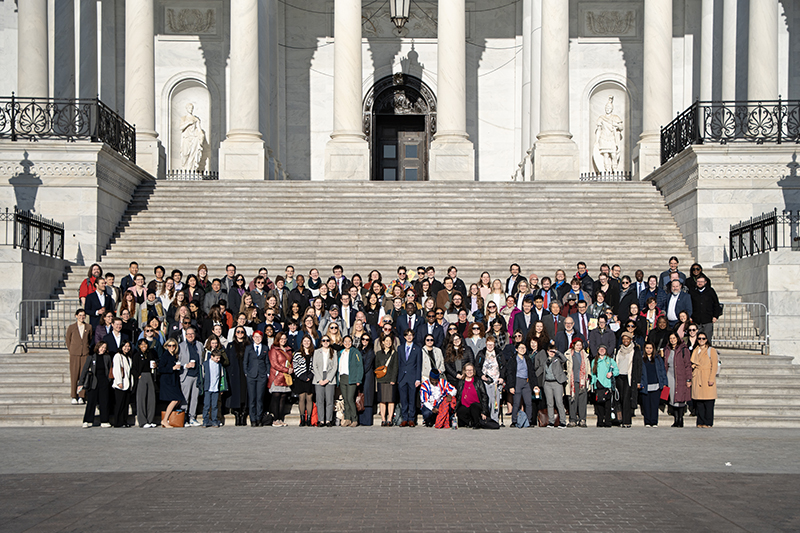
So, when our minivan pulled up outside the Capitol building at 7:30 AM on April 9, I was in awe. Seeing it looming over a garden of tulips against a bright blue sky made it appear even grander than images I’d seen. I must have whispered “wow” at least 17 times as I hopped out and made my way to the Capitol steps to join the growing crowd I’d be advocating alongside for the day.
TB Hill Day takes place annually, and this year it was organized in partnership between PIH Advocacy, We Are TB, the TB Roundtable, and TB Fighters—an incredible collaboration of activists, survivors, and health care advocates.
I hadn’t slept much the night before, feeling anxious and excited for our day of meetings with legislators and staff to advocate for critical TB resources. As the van pulled away, my thoughts began to spiral. What if someone completely shut us down? What if I got lost in the maze of underground tunnels connecting Congressional office buildings? What if I forgot everything I knew about TB at the exact moment it mattered most?
Luckily, we came prepared. The organizers and my PIH colleagues, along with PIH trustee and author John Green, shared their experiences, passed out matching lapel pins so we could spot each other in the halls, and armed us with talking points to underscore the urgent need for TB funding.
The longer I stood among that determined crowd, the more my nerves faded. Excitement took over. I wasn’t alone. Over 200 of us were ready to take on Congress in 210 meetings—94 with Senate offices and 116 in the House—representing 49 states. A massive jump from last year’s 35 meetings.
At a time when it’s easy to feel powerless in the political process, it felt pretty stinking cool to be part of this movement.
We soon walked away from the crowd at the Capitol’s grand steps and into one of the House office buildings. My first impression once inside was how accessible it seemed. As long as you made it through security—the metal detectors and bag scans—you could walk right in. No one asked me who I was or why I was there. For a building filled with such consequential people and remarkable history, I was surprised by its lack of exclusivity.
I was paired with Jen Furin, TB doctor and educator, and Rosie Poling, PIH’s health policy officer. I quickly learned that Rosie is not only a brilliant advocate, but one who comes stocked with fruit snacks for anyone needing an energy boost amid the repetitive nature of our meetings. She also navigates the Senate and House buildings like a seasoned pro. My fear of getting lost dissipated—especially once I discovered the buildings are equipped with cafeterias, barber shops, and gift shops. I could survive here for a while if needed.
One of our early meetings was with the office of a representative from Ohio. It was the first of several conversations with folks I don't necessarily see eye-to-eye with politically. Sitting at the large, round table in a cramped staff room, I found myself feeling defensive. But that quickly changed. The staffer was kind, asked thoughtful questions, took notes, and requested follow-up materials. Jen, a constituent of their Ohio district, shared knowledge of the issues on the ground in her hometown, and we were joined by two TB fighters, also from Ohio, who reinforced her message.
I can be painfully optimistic—sometimes naïve—about people’s intentions. But I left that meeting feeling hopeful. There’s certainly an element of political courtesy during Hill Day. But this first meeting was an essential reminder that members of Congress, and their staffers, are human just like us. Many genuinely want to do right by their constituents—or, at the very least, be seen as responsive during re-election season.
Several offices remembered PIH from past TB Hill Days, and most folks were generally aware of TB and its destructive nature. Still, a common theme emerged: uncertainty. Every office I met with expressed concern over rapidly shifting policy and health budgets, both domestically and globally. Our asks—modest, considering the scope of the overall federal budget—were met with interest but tempered by a wait-and-see stance considering funding cuts, lawsuits, and budget resolutions.
Even so, the staffers we met with were incredibly respectful and receptive. I began picking up on their specific “catch phrases”—polite expressions like “I hear you,” “I see where you’re coming from,” or “I understand.” I couldn’t always tell how sincere they were, but I was fascinated by how Rosie and Jen tailored our messaging to each of them. They knew what would ultimately make that office care. Like, for instance, that Alaska has the highest TB rates in the U.S., or that Kansas is currently facing an outbreak that could easily spread to neighboring Nebraska.
Later, our trio of “women who do things,” as Jen dubbed us, trekked from one side of the Capitol to the other. When we arrived at the Senate buildings, a long line wrapped around the block. Even with Rosie’s insider knowledge about a sneaky side entrance, we waited nearly an hour—quite a contrast from our morning entry.
Seeing the sheer number of people assembled, waiting, empowered to speak with their senators, was encouraging. It reinforced what I’d come to believe throughout the day: anyone can participate in this democratic process. For something I’d built up as intimidating, the day turned out to be a remarkable learning experience—and dare I say, fun. I am truly grateful to the Advocacy Team, and to the TB experts, doctors, survivors, and activists who generously shared their expertise. Without their support, I wouldn’t have learned half as much.
Like the beautiful castle grounds I’ve loved exploring all my life, the Capitol buildings—and the people they hold—are very much within reach. The day reminded me that members of Congress are people who have been chosen as our leaders, people who are meant to represent our values. We can talk to one another, learn from one another, and, in partnership, we have the power to make history. If we keep showing up—together, on the same day, in the same place—like we did on April 9th, I believe I’ll see the elimination of TB in my lifetime.